
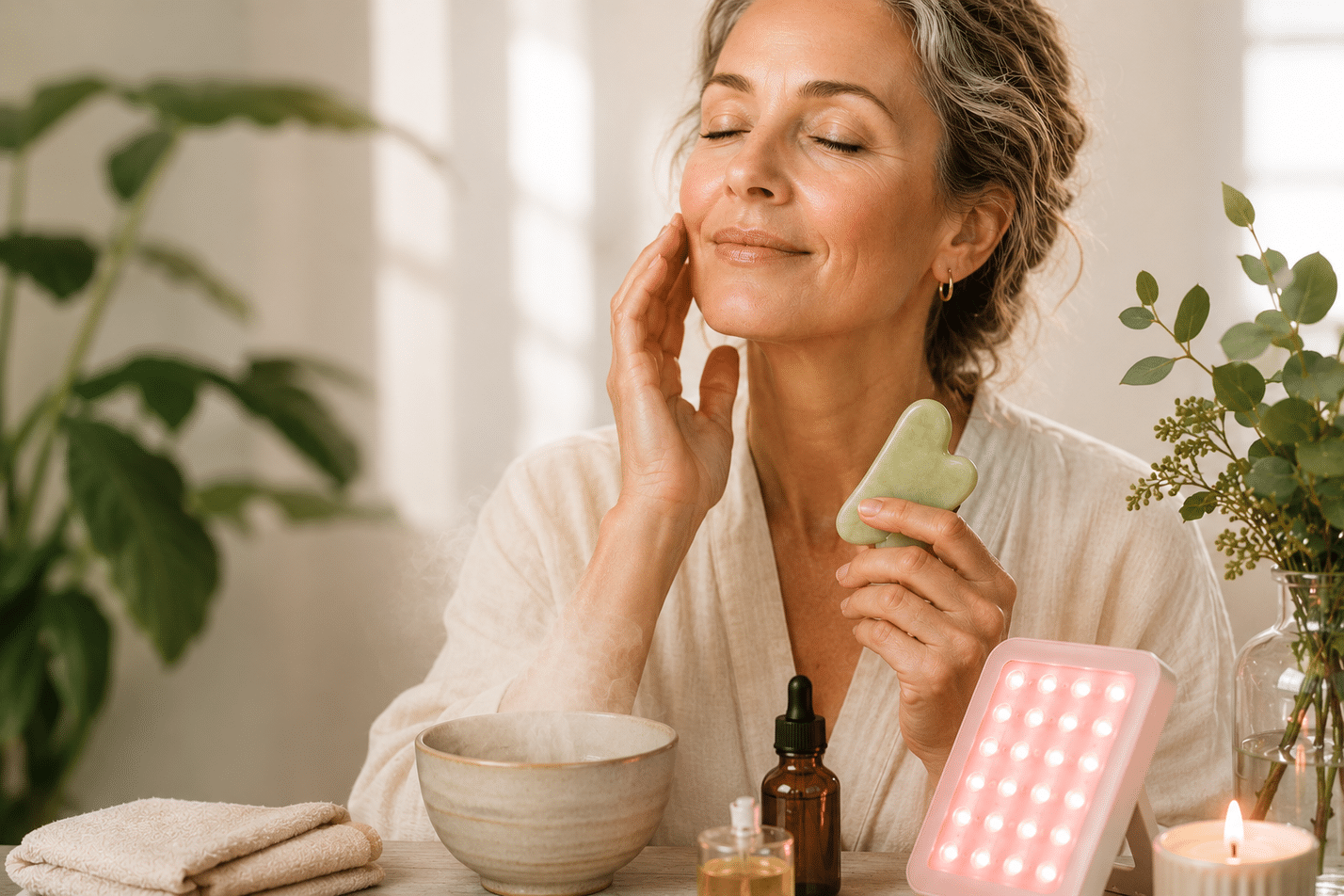
It’s Just Changing and Here’s How to Support It:
Okay, let’s talk about something no one really prepares us for.
You’re drinking your water. You’re trying to get enough sleep. You’re investing in the serums. You’re doing all the “right” things…
And yet your skin feels different.
Maybe, it’s drier. Maybe, it feels thinner. Maybe, that effortless glow you used to wake up with isn’t showing up the same way anymore.
You’re not imagining it.
Your skin is changing because your hormones are changing, and during perimenopause and menopause, your skin is one of the places where those shifts can become very noticeable.
The good news? Once you understand what’s happening, you can support your skin instead of constantly fighting against it.
So, What’s Actually Happening?
Estrogen plays a much bigger role in skin health than most people realize. It helps support collagen production, hydration, elasticity, and the strength of your skin barrier.
So when estrogen starts to decline, your skin feels those changes, too.
Collagen production slows down. Skin can become less firm and more prone to dryness. Your ability to hold onto moisture changes, and your skin barrier can become more sensitive.
Basically, your skin is adapting to a new hormonal environment.
But here’s what I love about the human body: It is always responding to support. We can work with these changes instead of feeling like we are constantly battling them.
Here are five ways you can support your skin naturally.
Red Light Therapy
When I first heard about people using red light therapy on their faces, I’ll admit, I was skeptical.
It sounded a little like a sci-fi beauty experiment.
But after looking into the research, I understood why it has become so popular.
Red light therapy (also called photobiomodulation, which is just a fancy word for using specific wavelengths of light to influence cellular function) works by supporting your mitochondria, the energy centers inside your cells.
When your cells have more energy, they can do their jobs more effectively, including supporting collagen production and skin repair.
For women in midlife, this is especially interesting because it supports some of the same processes that were greatly influenced by estrogen during reproductive years.
Research has shown that consistent red light therapy may improve things like skin texture, elasticity, fine lines, and collagen density.
The key here is consistency. This is not a “use it once and wake up looking 10 years younger” situation (because unfortunately, those products do not exist).
Think 10–20 minutes, a few times per week, and give your skin time to respond.
Gua Sha
Gua Sha has been used in Traditional Chinese Medicine for centuries, and I love that many of these traditional practices are finally getting more attention.
Facial Gua Sha uses a smooth tool and gentle movements across the skin to support circulation, lymphatic flow, and relaxation of facial tension.
And let’s be clear, it is not a facelift in a stone.
But that immediate glow people notice afterward? A lot of that comes from increased circulation and helping move fluid that may be contributing to puffiness.
For many women during hormonal transitions, this can be a beautiful addition to a skincare routine.
The biggest mistake people make is pressing too hard. Your face does not need aggressive treatment. It needs support.
Apply oil first, then gently move from the center of your face outward and sweep down toward your neck. A few minutes, a few times per week, is plenty.
Facial Steam
This one is beautifully simple.
Warm water. A towel. A few minutes.
That’s it.
Steam can soften the skin, temporarily increase hydration, improve circulation, and help prepare your skin for the products you apply afterward.
If you’re investing in quality serums and moisturizers, creating the right environment for them to work matters.
Try steaming after cleansing for 5–10 minutes, then apply your skincare while your skin is still warm and hydrated.
A quick note: if you have rosacea or very reactive skin, heat may increase redness, so always listen to what your skin is telling you.
Facial Lymphatic Drainage Massage
Your lymphatic system is one of the most underrated systems in your body.
Unlike your cardiovascular system, it doesn’t have a pump. It relies on movement, breathing, and gentle pressure to help keep fluid moving.
When things slow down, many women notice it in their face.
The puffiness around the eyes. The fuller jawline. The “why do I look tired even after sleeping?” feeling.
Facial lymphatic drainage massage can help support that natural movement and reduce fluid buildup.
The key word is: gentle.
Lymph vessels sit close to the surface of your skin, so more pressure does not mean better results.
Start at your neck first, sweeping down towards your collarbone. Then gently move outward from the center of your face, and finish by sweeping down toward your collarbone again.
Five to ten minutes is enough.
Collagen Peptides
I’ll be honest, I was skeptical about collagen supplements for a long time.
The beauty industry has a long history of selling us things that sound amazing but don’t always deliver.
But collagen research has become much more compelling.
Hydrolyzed collagen peptides provide amino acids that can support your body’s own collagen-building processes. You’re not just eating collagen and hoping it magically appears in your skin, your body uses those building blocks to support your tissues.
Research has shown benefits related to skin hydration, elasticity, and the appearance of fine lines when collagen is used consistently.
A common approach is 5–10 grams daily, giving it 8–12 weeks before deciding whether it is making a difference.
And don’t forget vitamin C. Your body needs it for collagen production.
Putting It All Together (Without Losing Your Mind)
You do not need to do all of these things every single day.
Please do not turn your skincare routine into another thing you feel like you have to “keep up with.”
Start simple.
Maybe that looks like collagen peptides in your morning coffee, tea, or smoothie. Maybe it’s a few minutes of facial massage while you’re already applying your skincare. Maybe it’s red light therapy a few evenings per week.
The goal is not perfection. The goal is consistency.
The theme behind all of these practices is simple: you are working with your body, not against it.
Your skin is not betraying you. It’s communicating with you.
It is adapting to a new season, just like the rest of you is.
And when we understand what our bodies need, we can stop chasing quick fixes and start caring for ourselves in a way that actually feels empowering.
With love,
Coach Monica
References
1. Thornton MJ. (2013). Estrogens and aging skin. Dermato-Endocrinology, 5(2), 264–270.
2. Rzepecki AK et al. (2019). Estrogen-deficient skin: The role of topical therapy. International Journal of Women’s Dermatology, 5(2), 85–90.
3. Gasser A et al. (2025). Managing Menopausal Skin Changes: A Narrative Review. Journal of Cosmetic Dermatology. PMC12374573.
4. Hamblin MR. (2016). Shining light on the head: Photobiomodulation for brain disorders. BBA Clinical, 6, 113–124.
5. Avci P et al. (2013). Low-level laser (light) therapy (LLLT) in skin: Stimulating, healing, restoring. Seminars in Cutaneous Medicine and Surgery, 32(1), 41–52.
6. Wunsch A, Matuschka K. (2014). A controlled trial to determine the efficacy of red and near-infrared light treatment. Photomedicine and Laser Surgery, 32(2), 93–100.
7. Gambacciani M et al. (2024). Non-ablative dual-wavelength diode laser therapy for GSM in women contraindicated for HRT. Advances in Therapy.
8. Zhao J et al. (2012). Red light and the sleep quality and endurance performance of Chinese female basketball players. Journal of Athletic Training, 47(6), 673–678.
9. Ahn J et al. (2025). Comparative Effects of Facial Roller and Gua Sha Massage on Facial Contour, Muscle Tone, and Skin Elasticity: Randomized Controlled Trial. Journal of Cosmetic Dermatology. DOI: 10.1111/jocd.70236.
10. Nielsen A et al. (2007). The effect of Gua Sha treatment on the microcirculation of surface tissue: A pilot study in healthy subjects. Explore, 3(5), 456–466.
11. Guney-Deniz H et al. (2022). Clinical lymphatic drainage. Physiotherapy Theory and Practice. DOI: 10.1080/09593985.2022.2044422.
12. Hamp J et al. (2023). Gua-sha, Jade Roller, and Facial Massage: Are there benefits within dermatology? Journal of Cosmetic Dermatology, 22(2), 700–703.
13. Journal of Cosmetic Science — cited in: Robynskincare.com. (2025). The Science-Backed Guide to Facial Steaming.
14. WebMD. (2024). What to Know About Facial Steaming. webmd.com/beauty/what-to-know-facial-steaming.
15. Healthline. (2024). Benefits of Steaming Face. healthline.com/health/benefits-of-steaming-face.
16. Donahue PMC et al. (2023). Advances in the prevention and treatment of breast cancer-related lymphedema. Breast Cancer Research and Treatment, 200(1), 1–14.
17. Drozdova-Statkevičienė M, Ančiukaitė G. (2023). Effects of vacuum procedures on mature facial skin. Taikomieji Moksliniai Tyrimai, 2(2), 234–243.
18. PMC Scoping Review. (2025). An Update on the Role of Lymphatic Function in Skin Inflammatory Disorders. PubMed Central.
19. Cleveland Clinic. (2024). Lymphatic Drainage Massage. my.clevelandclinic.org/health/treatments/21768-lymphatic-drainage-massage.
20. Reilly D et al. (2024). A Clinical Trial Shows Improvement in Skin Collagen, Hydration, Elasticity, Wrinkles, Scalp, and Hair Condition following 12-Week Oral Intake of a Supplement Containing Hydrolysed Collagen. Dermatology Research and Practice, 8752787.
21. AgroFOOD Industry Hi Tech. (2024). Effect of collagen peptides intake on skin conditions: a clinical trial. 35(2).
22. Cao C et al. (2025). Effects of Collagen Supplements on Skin Aging: A Systematic Review and Meta-Analysis of Randomized Controlled Trials. The American Journal of Medicine.